Creatine and Menopause: What Studies Have Looked At So Far
By The glow team Published 4 min read
The short answer: most research on creatine and menopause has been in postmenopausal women and has looked at muscle, strength and bone, usually alongside resistance training. Results on muscle and strength are mixed, findings on bone are mixed, and work on the brain and mood is early. No study we found shows that creatine treats menopause symptoms such as hot flushes. This article is a summary of research, not a reason to take any product for menopause.
Creatine is not only a midlife topic: see our complete guide to creatine for women for every stage. For the age-specific question, see creatine for women over 50.
Why researchers have looked at this
Oestrogen levels fall through perimenopause and after menopause, and muscle and bone tend to decline with age. A 2021 review of creatine in women's health discusses why researchers think creatine is worth studying at this life stage. Much of that thinking is mechanistic, meaning it describes how creatine might act rather than showing that it does.
What the studies found on muscle and strength
The findings are not all in one direction.
- The 2021 review describes several trials in postmenopausal women where creatine plus resistance training led to bigger gains in strength or lean mass than training alone, and others where it added nothing on some measures.
- It reports that low doses taken for a long time without training showed no effect on muscle, bone or function compared with placebo.
- A 2026 meta-analysis of seven trials in 608 postmenopausal women found small gains in lean mass and leg press strength, mainly when 5g or more a day was combined with resistance training. Trials using 3g a day or less without training showed no measurable effect.
- The largest trial so far, a two-year study in 237 postmenopausal women doing resistance training and walking, found no extra gain in bench press or squat strength with creatine. It did report a slightly faster walking time, and more lean tissue in women who stuck closely to the programme.
So where creatine has shown an effect in these trials, it has been alongside training rather than instead of it.
What the studies found on bone
Bone gets a lot of attention online, and it deserves caution.
- A 12-month trial by Chilibeck and colleagues, published in 2015, reported less bone loss at the femoral neck in women taking creatine during resistance training than in those taking placebo. It was small: 47 women were randomised and 33 were analysed.
- The same team's larger two-year trial in 237 women found no effect on bone mineral density at the hip or spine, although some measures of hip bone shape changed.
Overall, the picture on bone density is mixed. If you are worried about bone health, speak to your GP about strength training, calcium and vitamin D, and any treatment they recommend.
What about brain fog and mood
Many women ask about creatine for brain fog and low mood around menopause. Research here is early, and we list what has been studied in creatine and the brain. The 2021 review describes small trials of creatine alongside antidepressants in women, but these were not menopause studies. A 2024 study during sleep deprivation gave one very large dose (0.35g per kg of body weight) to 15 young adults, far more than anyone takes day to day.
We found very little research designed around perimenopause specifically. Most trials have recruited postmenopausal women. The honest position is that researchers are interested and the evidence is not there yet.
What creatine has not been shown to do
We found no research showing that creatine eases hot flushes, night sweats or the hormonal changes of menopause. If your symptoms are affecting your life, your GP or a menopause specialist can talk you through the options, including HRT.
Collagen and menopause
Collagen is a separate topic with its own, different evidence base. See collagen and menopause.
How much do studies use
Postmenopausal trials have used a wide range, from 1g to 3g a day in low-dose studies to 0.1 to 0.14g per kg of body weight a day in training trials, and some used short high-dose loading.
Safety
Creatine has a strong safety record in healthy adults, and the 2021 review reports no more adverse effects than placebo in postmenopausal trials. See is creatine safe for women. Speak to your doctor first if you have kidney problems or another long-term condition, or take regular medication, including HRT.
About glow Creatine Gummies
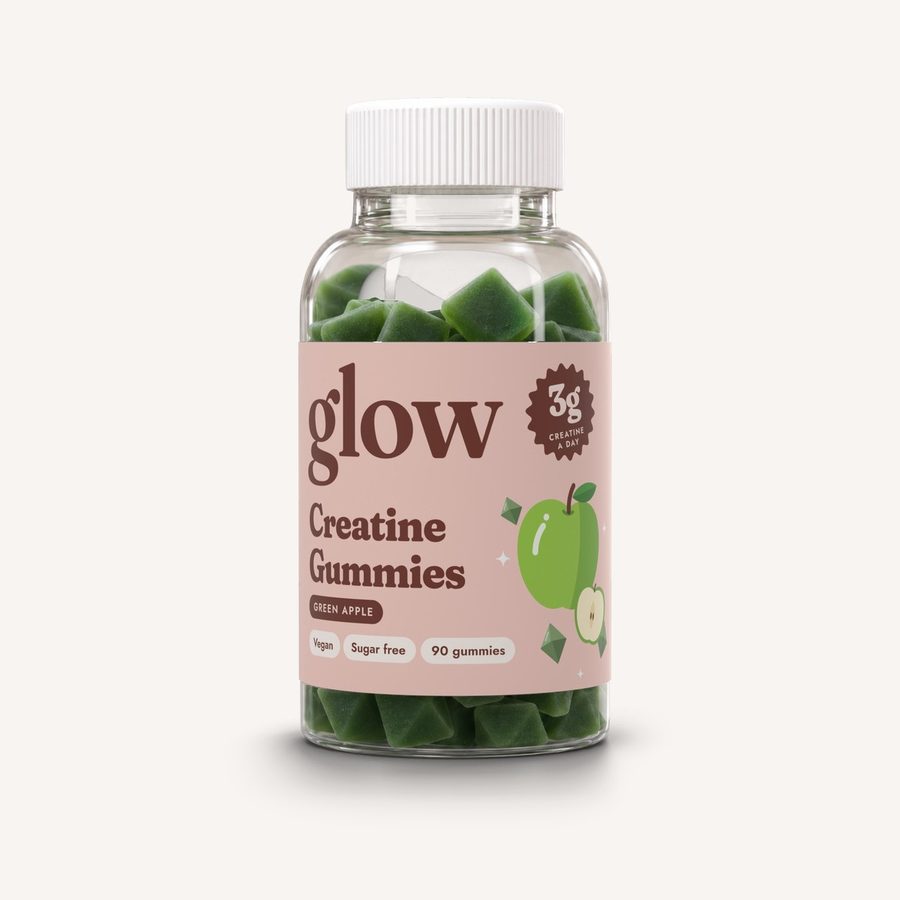
glow Creatine Gummies are apple gummies with 1,195mg creatine monohydrate per gummy, equivalent to 1,000mg creatine; three gummies give 3g of creatine, the daily amount the GB claims are based on. They are vegan and sugar free, 90 gummies a pot. Free UK delivery. They are a food supplement and are not intended to treat or prevent menopause symptoms, bone loss or changes in mood or memory.
The authorised GB claims for creatine are:
"Creatine increases physical performance in successive bursts of short-term, high intensity exercise. The beneficial effect is obtained with a daily intake of 3g of creatine."
"Daily creatine consumption can enhance the effect of resistance training on muscle strength in adults aged 55 and older. The beneficial effect is obtained with a daily intake of 3g of creatine in conjunction with resistance training."
FAQs
Does creatine help with menopause symptoms?
We found no evidence that it does. Studies have looked at muscle, strength, bone and brain function, not symptoms such as hot flushes.
Can I take creatine with HRT?
Ask your GP or pharmacist. The sources we reviewed did not describe a reason to avoid the combination, but your doctor knows your history.
Does creatine help bone density after menopause?
Studies disagree. A small one-year trial reported less bone loss at the hip, but a larger two-year trial found no effect on bone density. Speak to your GP about bone health.
Do I need to lift weights for creatine to make a difference?
The studies in postmenopausal women that reported effects on muscle or strength paired creatine with resistance training.
More on creatine for women: the complete guide.
This article is for general information and is not medical advice. If you have a health condition or take medication, speak to your doctor before taking a supplement.

glow Creatine Gummies
A full 3g of creatine a day in three green apple gummies. Vegan, sugar free, free UK delivery.
£24.95 a pot · about £0.83 a day
Shop Creatine GummiesKeep reading

