Creatine for Women: The Complete Guide
By The glow team Published 7 min read
The short answer: creatine is a compound your body already makes and stores in muscle, where it helps supply energy for short, hard efforts. Taking a supplement tops those stores up. For healthy adults the research says it is safe at normal doses, and the usual amount in studies is 3 to 5g a day. Most of the older research was done in men, so this guide tells you where the evidence in women is strong, where it is mixed and where it is still thin.
What creatine is and what it does
Your liver and kidneys make creatine from three amino acids (arginine, glycine and methionine), and you also get some from meat, as the International Society of Sports Nutrition (ISSN) explains. Most of it ends up in your muscles as phosphocreatine, which helps your cells rebuild ATP, their energy currency, very quickly during brief, intense effort such as a sprint, a heavy set or a run up the stairs.
A fuller explanation is in what does creatine do. The short version is that more phosphocreatine in the muscle means a bit more in the tank for short bursts, which is why it has been studied so much in training.
Is creatine different for women
The same compound works the same way, but a few things do differ. A 2021 review of creatine in women's health reports that women have 70 to 80% lower endogenous creatine stores than men, and that women eat less dietary creatine on average. It also notes that resting muscle creatine is about 10% higher in women, which in theory could mean women respond less and need higher doses. The authors treat that as an open question, and conclude that women can follow the same dosing as men.
Two of that review's authors advise a creatine manufacturer, which paid the publication fee. The studies it describes are real trials, but it is worth knowing where the money sits.
The practical point is that studies in women use the same doses as studies in men, and nobody has found that women need a separate product. Pink packaging does not change the chemistry, as we explain in best creatine for women.
What the research says creatine may do
Strength and short, hard efforts
This is the best-supported area. The 2021 review describes trials in young women where creatine, taken alongside resistance training, led to larger gains in strength and fat-free mass than training alone in some studies, and no extra benefit in others. Its summary is that the evidence is positive overall but not unanimous.
Muscle and strength after menopause
Trials in postmenopausal women are mixed. A 2026 meta-analysis of seven randomised trials (608 women, average age about 62) found small gains in lean mass and leg press strength, mainly with 5g or more a day alongside resistance training. Trials using 3g or less without training showed no measurable effect, so the research behind these findings used more than the 3g a day the GB claims are based on. We go through this in creatine for women over 50 and creatine and menopause.
Bone
The picture is mixed and leans towards no effect on bone density. The largest trial, 237 postmenopausal women over two years, found no effect on bone mineral density, though creatine did maintain some measures of hip bone geometry.
Brain and mood
There is early research, mostly small studies, on mood, thinking and sleep loss. The 2021 review describes it as clinical and pre-clinical work and calls for more. Treat it as interesting rather than proven, and read creatine and the brain for what has actually been tested.
What it does not do
There is no research showing that creatine treats menopause symptoms such as hot flushes, so we do not suggest it does.
Is creatine safe for women
For healthy adults, yes, according to the evidence. The ISSN position stand concluded that short and long-term supplementation (up to 30g a day for five years in some studies) is safe and well tolerated in healthy people. A systematic review of 29 studies with 951 female participants found no deaths or serious adverse events and no significant differences in total adverse events, stomach and gut events, or kidney and liver measures compared with placebo.
Full detail is in is creatine safe for women, and the everyday effects people notice are covered in creatine side effects.
Kidneys
Creatine breaks down to creatinine, which doctors use to estimate kidney function. Supplements can raise blood creatinine without harm to the kidneys, so tell whoever orders a blood test that you take it. If you have a kidney condition, speak to your doctor first.
Weight and bloating
Water moves into muscle cells, and some people see a small rise on the scales in the first days, mostly during loading phases of around 20g a day. The ISSN review found that creatine did not increase fat mass across a range of groups. The full picture is in does creatine make you gain weight.
Hair loss
The worry traces back to a single 2009 study of about 20 male rugby players, which found a rise in DHT within the normal range and did not measure hair. The ISSN says it has not been replicated. A later 12-week trial in men taking 5g a day found no differences in DHT or hair measures. There is no trial in women, which we are upfront about in does creatine cause hair loss in women.
How much creatine to take
The ISSN describes 3 to 5g a day as the usual range. Two routes get muscle stores up. Loading (about 20g a day for five to seven days) gets there fastest, and 3 to 5g a day gets you to a similar place in around four weeks. You do not have to load. In the classic comparison, 3g a day for 28 days raised muscle creatine by about the same amount as 20g a day for six days.
Practical guides:
- How much creatine should a woman take covers 3g, 5g and what studies use.
- Creatine loading phase explains whether it is worth it.
- When to take creatine looks at morning, night and training timing.
- How long does creatine take to work sets out what to expect over the first weeks.
Do you need to exercise
Most of the best evidence is for creatine alongside resistance training, and the research on creatine alone is more modest. The ISSN review says creatine without exercise is unlikely to produce substantial gains in strength. If you do not lift, can you take creatine without working out explains what the research does and does not show, and strength training for women over 50 is a simple way to start.
Choosing a creatine
The form with the research behind it is creatine monohydrate, and there is more on why in creatine monohydrate. The things that really differ between products are the dose per day, the format, what else is in it and the price per day.
- Best creatine for women sets out the criteria.
- Creatine gummies: what to check before you buy is a label-reading checklist.
- Do creatine gummies work compares gummies with powder.
- Creatine for vegetarians and vegans covers a group with lower dietary intake.
If you are curious how it compares with another popular supplement, see collagen vs creatine.
Creatine through the years
Women take creatine at every age, and the questions change. In your twenties and thirties it is mostly about training. Around perimenopause and beyond, it is about keeping muscle and strength, where creatine and menopause and creatine for women over 50 look at what trials in older women have found. The same product and the same daily amount apply whatever your age.
Pregnancy and breastfeeding
The 2021 review found no human studies of creatine supplements in pregnancy, only animal research. Speak to your midwife or GP before taking it if you are pregnant, trying to conceive or breastfeeding.
glow Creatine Gummies
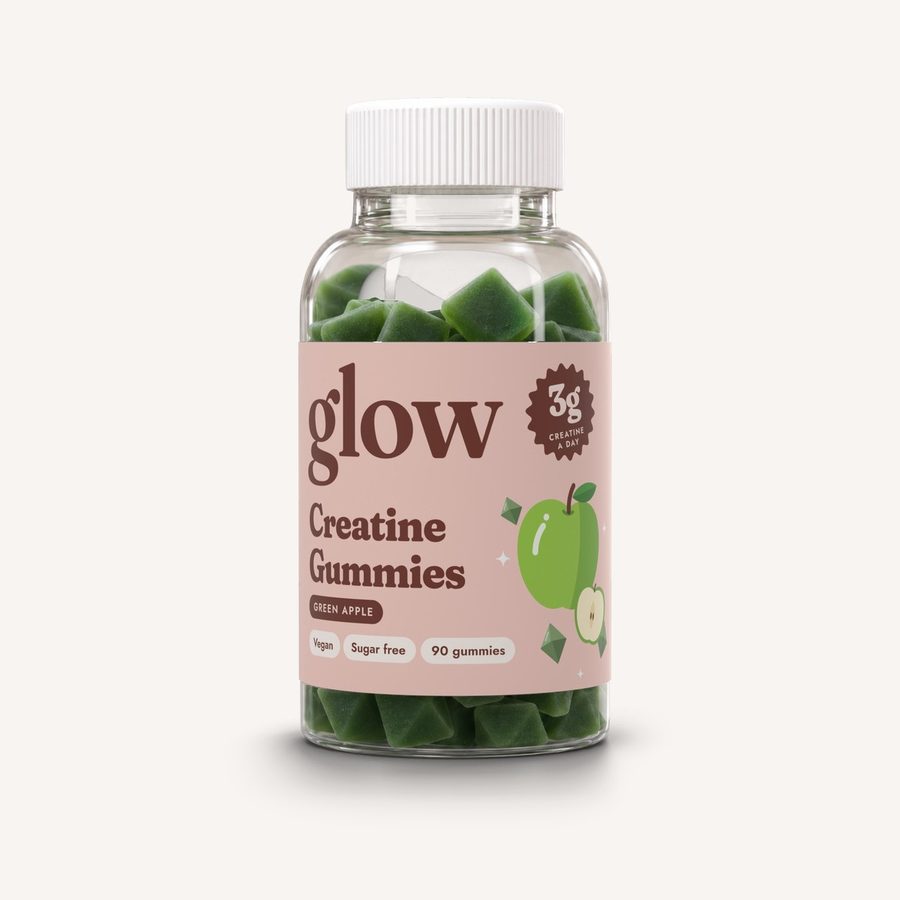
glow Creatine Gummies are natural apple gummies with 1,195mg creatine monohydrate per gummy, equivalent to 1,000mg creatine; three gummies give 3g of creatine, the daily amount the GB claims are based on. A pot holds 90 gummies, so 30 days. They are vegan and sugar free, with free UK delivery and a 30-day money-back guarantee on first orders. You can buy 1, 3 or 6 pots, and Auto Ship brings a new supply every 4, 12 or 24 weeks at a lower price, which you can skip or cancel any time.
Creatine increases physical performance in successive bursts of short-term, high intensity exercise. The beneficial effect is obtained with a daily intake of 3g of creatine.
Daily creatine consumption can enhance the effect of resistance training on muscle strength in adults aged 55 and older. The beneficial effect is obtained with a daily intake of 3g of creatine in conjunction with resistance training.
Prefer to scoop? glow Creatine Powder is coming soon: pure creatine monohydrate, one 3g scoop a day, unflavoured, in a 300g tub of 100 servings. See glow Creatine Powder
FAQs
Is creatine good for women?
Research reviews in women report benefits for strength and short, intense efforts when it is combined with training, and no more side effects than placebo at normal doses. Evidence on other areas, such as bone, mood and thinking, is mixed or early.
How much creatine should a woman take a day?
Studies use 3 to 5g a day, and many trials in postmenopausal women used 5g or more. The GB-authorised claims for creatine are based on 3g a day.
Will creatine make me bulky?
The 2021 review calls fears of weight gain largely unfounded in women and says strength gains in many trials came without large changes in body weight. A temporary water rise is possible, mostly with loading.
Can I take creatine if I do not lift weights?
You can, but the evidence for muscle and strength benefits is strongest alongside resistance training.
Can I take creatine while pregnant or breastfeeding?
There are no human studies in pregnancy, so speak to your midwife or GP first.
This article is for general information and is not medical advice. If you have a health condition, are pregnant or breastfeeding, or take medication, speak to your doctor before taking a supplement.

glow Creatine Gummies
A full 3g of creatine a day in three green apple gummies. Vegan, sugar free, free UK delivery.
£24.95 a pot · about £0.83 a day
Shop Creatine GummiesKeep reading

